News
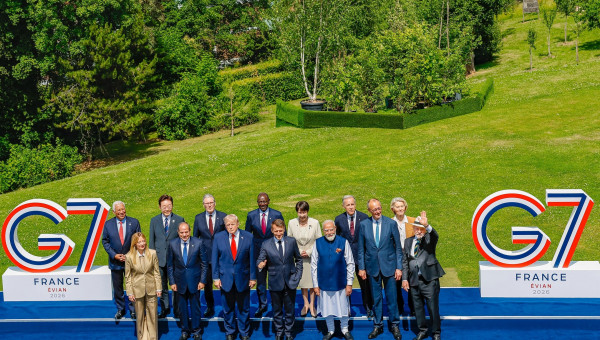
The G7 Summit took place in Evian, France, from 15 to 17 May, with Chancellor Merz in attendance. In an effort to accommodate the current US administration, this year’s G7 communiqués make no mention of terms such as ‘sustainability’, ‘gender’ or ‘Agenda 2030’. Nor were any relevant measures agreed upon to achieve significant progress in these areas.
The European heads of state and government emerged from Evian looking weak. Particularly shameful was the capitulation of the French G7 presidency under Macron. Since 2015, France has consistently portrayed itself as a champion of the Paris Agreement, the landmark UN climate accord named after its capital. Yet in Evian, the French presidency backed away from prominently championing climate action, sustainability and the 2030 Agenda in order to avoid confrontation with Trump.
A new partnership with the Global South, but without any transfer of funds?
In the run-up to the G7 summit, organisations such as Oxfam and ONE criticised the fact that the G7 is responsible for the bulk of the cuts to development cooperation funding in recent years. Africa has been particularly hard hit by this. Furthermore, in a detailed analysis of progress on reforms to the international financial architecture, the French NGO Focus 2030 demonstrated that the G7 has so far failed to live up to its responsibility as a dominant player in this field.
Of particular note in this context are the new Principles for Mutually Beneficial International Partnerships, which are annexed to the finance ministers’ communiqué. Rather than focusing on G7 contributions, the principles emphasise the mobilisation of the Global South’s own domestic resources, and in particular the mobilisation of private investment. Development banks and thematic funds are to broaden their donor base, but without undermining the “existing governance frameworks”. The G7 wants to have it both ways: It doesn’t want to put any of its own money on the table, yet still wants to call the shots.
Disregard for the United Nations
Also noteworthy in the Evian declarations is the consistent disregard for the processes and resolutions of the United Nations, of which the G7 states remain members. For instance, whilst the finance ministers’ communiqué does address the need for better taxation of companies, particularly digital corporations, it refers only to the processes at the OECD and makes no mention of the fact that a convention is currently being negotiated within framework.
Nor does it say a word about the Compromiso de Sevilla, the outcome of the Fourth UN Conference on Financing for Development held in Spain last year. This is despite the fact that the UN agreement contains numerous commitments on mobilising domestic resources and private investment, as well as on reforming the international financial architecture to grant the Global South greater influence. The US withdrew from both UN processes during Donald Trump’s second term in office.
Brazil shows how it should be done
Whilst the submissive stance adopted by European heads of state and government towards ‘King Donald’ drew harsh criticism from the sustainability community, Brazilian President Lula’s stance was highly praised. He had been invited merely as a guest, as Brazil is not formally a member of the G7. Lula explained that the implementation of the SDGs continues to be hampered by an annual financing gap of 4 trillion US dollars. The Sevilla Commitment points in the right direction.
In practice, however, developing countries have to spend seven times more on debt servicing than they receive in official development assistance from rich countries, partly due to massive cuts in ODA by the G7. He denounced the fact that the world’s richest man, with over 1 trillion US dollars, owns almost as much wealth as the poorer half of the world’s population combined, whilst funding for international organisations such as the UN´s children’s fund UNICEF and for efforts to fight hunger has been slashed. Brazil is a member of the G20, whose leaders will meet again in December this year in the realm of King Donald.
