News
As the task force working on the WHO-led reform process prepares its interim report by November, we ask global health experts: Can this process deliver a more equitable global health system? Our three-part interview series with Dr Amitabha Sarkar (Tampere University, United Nations Research Institute for Social Development (UNRISD)), Dian Maria Blandina (United Nations University) and Aggrey Aluso (Resilience Action Network Africa (RANA)), explores what meaningful reform would look like, whose voices are shaping the debate and whether countries and communities with less influence will gain greater control over the decisions that affect their health.
Dr Amitabha Sarkar is a public health researcher and practitioner working at the intersection of global health policy, international development, human rights and health systems. His two decades of public health experience span multiple continents and encompass work ranging from community health mobilisation to global health programme design. He is a Senior Research Fellow at Tampere University, Finland, and a Research Fellow at the United Nations Research Institute for Social Development (UNRISD) in Geneva. He is also an honorary Research Associate at the Albert Hirschman Centre on Democracy at the Geneva Graduate Institute, and a long-term affiliate of the People’s Health Movement (PHM).
Looking at the process so far, what gives you the most reason for optimism, and what concerns you most?
Amitabha: Let me start with the broader political context. The global order is becoming increasingly multipolar. Countries are pursuing multiple affiliations, and international relations are becoming more transactional and more determined by geopolitics and geoeconomics.
Against this backdrop, WHO deserves credit for bringing the global health architecture reform into a multilateral space. With this process, WHO is endorsing multilateralism, which I believe is not an ideology, but a doctrine and a discipline to produce rules based governance and ensuring their conscientious implementation.
The composition of the Task Force is also encouraging. It brings together Member States, UN entities and regional health organisations, including Africa CDC. The pairing of co-chairs from developing and developed countries is noteworthy. I also welcome the recognition of subsidiarity and country ownership as core principles. Another positive development is the inclusion of product innovation and access in the discussion. These are fundamental questions of governance.
My immediate concern, however, is the compressed political timetable. Delivering recommendations on such a broad administrative, diplomatic and governance task within roughly a year, before the next World Health Assembly, is extremely difficult.
We should also distinguish agreement between institutions from institutional reform. Institutions may agree on broad language without being willing to change their mandates, identities or decision-making power.
It is also not yet clear how the process will address the redistribution of power. The reform was initiated against a backdrop of a substantial decline in official development assistance and a crisis in multilateralism. Both are ultimately questions of power, as is financing and agenda-setting. Whether the process will seriously address these questions, remains to be seen.
What would meaningful change look like from your perspective, and how realistic is it that this process will deliver it?
Amitabha: So far, the changes are primarily at the level of process. I would describe the current stage as a “process architecture”.
The next step must be to move beyond WHO-led coordination exercise towards an architecture that operates across levels, including at country level. The acceptance of subsidiarity, country ownership, equity, coherence and accountability as guiding principles is welcome. So is the proposal to map functions across global, international, regional and national levels. Such mapping could help identify how financing might be reformed to support national self-reliance and regional functions.
The deeper question is whether substantive reform will follow. Will the Task Force identify functions that should move away from global institutions and be exercised at regional or national level? The text adopted by the 79th World Health Assembly states that mandate rationalisation and mergers are not the purpose of this exercise. That raises a legitimate question about how far the process can go.
A second test is whether institutions and programmes funded by different actors will allow countries greater control over their priorities and programme design, or whether funders will retain that control.
Innovation, technology and access have found their way in the official WHO document on the process but are framed as technical or programme-related matters. They should instead be treated as structural governance questions. This is what the public health community expects from the reform: concrete outcomes, not an abstract agenda.
Which actors do you expect to have the greatest influence on the reform discussions?
Amitabha: We need to understand the political economy of global health reform. Member States are arguably the most powerful actors in a WHO-led process, but their positions are shaped by their own domestic capacities and interests.
We expect a reform to deliver universal health for all, but we need to understand the starting positions of the governments involved. The EU and its member states, for example, may favour stronger intellectual property protection, while developing economies may have different priorities. These positions are connected to their domestic economic structures, capacities and interests.
My argument is that we need to recognise “normative pluralism” in multilateral affairs. For example, the Pandemic Accord negotiations revealed differing Member State perspectives on global health cooperation. High-income countries prioritise global health security through stronger surveillance and timely access to pathogen genetic sequencing, middle-income countries emphasise equitable access to medical countermeasures and health technologies, and least developed countries stress solidarity through predictable, unconditional financing. These differences reflect distinct geopolitical histories and contextual interests rather than issues that can be resolved through better drafting alone. The joint process should therefore include a workstream on reconciling these values, exploring how security, equity, and solidarity can complement one another within a reformed global health architecture. Without this, efforts to improve coordination and streamline mandates risk resting on a contested foundation. They can overlap and complement one another. But global politics often turns them into competing priorities.
The reform therefore needs to address these divergent, but legitimate, positions rather than focus only on operational changes, institutional coordination and resource arrangements. If the Task Force fails to recognise normative pluralism, its recommendations may encounter resistance when they enter the intergovernmental process at the World Health Assembly.
Member States will remain influential, but other UN entities, institutions, private-sector actors and philanthropic foundations also matter. The key is not simply who has influence, but whether the process recognises the underlying differences in interests and takes responsibility for addressing them. Otherwise, it risks producing a polished document through skilful diplomacy without resolving the fundamental problems.
To what extent will low- and middle-income countries be able to shape the reform agenda?
Amitabha: The process offers a more institutionalised opportunity for engagement than many previous reform processes. This process concerns the global health architecture as a whole and responds to wider challenges, including the crisis in multilateralism and declining development assistance.
Low- and middle-income countries have a genuine opportunity to influence the process, but exercising it will depend on their ability to build coalitions, prepare technically for meetings, coordinate regionally and connect governance reform with financing and technology.
Initiatives such as the Accra Reset and the Lusaka Agenda can contribute to coalition-building. If low- and middle-income countries work together, they can put forward stronger regional governance proposals and make the case for regional health organisations to play a more substantial role. That would help them become agenda-setting actors, rather than simply participants at the table.
What are likely to be the main political fault lines or contested issues in the process?
Amitabha: I see several key fault lines:
- Global centralisation versus subsidiarity: This is ultimately a question of power and hegemony.
- WHO’s central role versus institutional pluralism: WHO presents itself as the central convening and normative institution, but the reform also involves organisations with their own mandates, structures and governance arrangements.
- Global security versus health equity: These priorities can be complementary, but they often compete for political attention and resources. Low- and middle-income countries may place greater emphasis on universal health coverage and long-term health-system development.
- Vertical programmes versus integration into country systems: The question is how externally supported programmes should relate to national health systems.
- Donor preferences versus country ownership: It remains to be seen whether countries will genuinely determine priorities and programme design.
- Representation versus agenda-setting: In particular, will low- and middle-income countries be able to shape decisions, rather than simply be represented?
- Fragmentation versus universalism: How should the architecture function when major powers do not fully participate in universal institutions? Given the instability of the global order, this is a question the reform should address.
- Global public goods versus national sovereignty: The process must consider how collective action can be sustained while respecting national autonomy.
- Innovation and intellectual property versus access: These tensions are often discussed as questions of intellectual property alone, rather than as broader questions of access.
- Evidence versus political bargaining: Technically appropriate proposals may still face resistance from governments or institutions whose mandates or interests could be affected.
In our submission, we also proposed a “confederate architecture” as a possible governance model for global health. It could help reconcile global collective action with national, regional and local autonomy, representation and effectiveness by distributing functions rather than concentrating them in particular institutions or levels. This idea has not yet found a place in the reform discussion, but it could offer a way to address several of the fault lines I have described.
GPF Europe: Several proposals have been put forward to strengthen the global health architecture. Which areas of reform do you consider most critical, and where should the process focus first?
Amitabha: First, there should be a rigorous mapping of functions and mandates. We need to understand which public, private, state and non-state actors perform which functions, and how their responsibilities are defined. Second, we need a map of the financing architecture. Third, we need to map the architecture for innovation, technology and access, focusing not only on institutional arrangements but also on how products move through the system. Fourth, regional governance needs to be examined: which functions should be performed regionally, and how should regional arrangements work?
Which aspects of the current reform debate are most problematic in your opinion?
Amitabha: The central risk is that coordination will substitute for structural reform. Improving coordination is politically easier than changing financing patterns, reallocating functions or changing who holds authority under existing mandates.
The reform must also define country ownership much more precisely. Does it mean that donors align their projects with national action plans, or does it mean that countries actually determine priorities and resource allocation and take responsibility for accountability?
Finally, the reform needs to consider how the architecture can remain resilient if major powers withdraw or refuse to participate. It should produce arrangements that can withstand, or at least mitigate, such defections.
GPF Europe: Looking at today's global health system, where do you see the greatest need for reform?
Amitabha: The greatest need is to reform the interfaces between the existing institutions: between mandates and financing; between global, regional and national levels; between donors and countries; and between global norms and national implementation.
We also need to address the relationship between emergency security responses and routine health systems, including universal health coverage.
How should the reform process address structural inequities in global health governance, particularly in research, innovation, technology transfer and access?
Amitabha: Innovation and access need to be treated as core governance functions, not as downstream technical or programme issues. Only then can the reform address structural inequalities.
I would suggest mapping the entire innovation chain: public research funding, agenda-setting, clinical research, intellectual property, regulatory approval, manufacturing, technology transfer, procurement, financing and distribution.
Access to medicines could be a particularly clear test of whether country ownership has substantive meaning. WHO previously ran a Drug Action Programme, beginning in the late 1970s and continuing for decades, to support countries in building national capacity for access to medicines and health technologies. The programme helped countries strengthen their infrastructure and become more self-reliant. The Essential Drugs List, now known as the Essential Medicines List, was part of this broader history. The lesson is that practical programme support can be driven by a wider governance objective.
What role can civil society play in the reform process?
Amitabha: Civil society should not be treated simply as another consultation category. It should have a role in developing and shaping substantive proposals. Consultation should be deliberately designed to support accountability for both the process and its outcomes, including transparency about how decisions are made and what they deliver.
What would be your one message to decision-makers involved in the process?
Amitabha: Please do not confuse redesigning the map with changing the territory.
The reform has already achieved something important by bringing fragmented discussions about global health reform into a formal, Member State-led multilateral process. WHO deserves credit for bringing these initiatives together and reinforcing confidence in a rules-based international order.
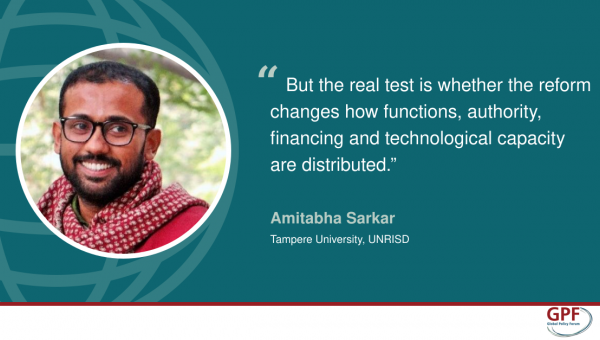
But the real test is whether the reform changes how functions, authority, financing and technological capacity are distributed. Regional institutions should become genuine governance actors where functions are better handled at regional level, while remaining coordinated with national systems.
The one-year timetable may help maintain political momentum, but the process must not end with a declaration focused only on coordination. It needs to lay the foundations for long-term structural change.
We should judge the reform not by how comprehensive the final document looks, but by whether a country with limited financial, technical and institutional capacity is demonstrably better able to set its own public health priorities and secure the global public goods it cannot provide on its own. That would be a meaningful outcome of the reform. I remain hopeful.
Dr. Sarkar was invited to take part in the GHA reform process, and officially submitted an input as part of the WHO stakeholder consultation in April 2026. It can be found below as a download.
