
News
As the task force working on the WHO-led reform process prepares its interim report by November, we ask global health experts: Can this process deliver a more equitable global health system?
Our three-part interview series with Dr Amitabha Sarkar (Tampere University, United Nations Research Institute for Social Development (UNRISD)), Dian Maria Blandina (United Nations University) and Aggrey Aluso (Resilience Action Network Africa (RANA)), explores what meaningful reform would look like, whose voices are shaping the debate and whether countries and communities with less influence will gain greater control over the decisions that affect their health.
Aggrey Aluso is a Kenyan health and social justice advocate and Executive Director of the Resilience Action Network Africa (RANA). He has held senior roles at the Open Society Initiative for Eastern Africa and the University of Manitoba’s Centre for Global Public Health, focusing on health equity and vaccine justice.
Looking at the process so far, what gives you the most reason for optimism about the WHO-led process to reform the global health architecture?
Aggrey Aluso: What gives me hope is that there is at least an official acknowledgement that the current global health architecture needs reform. Recognising that times have changed and circumstances have shifted is an important starting point.
I also appreciate the decentralised approach, with different actors and regions contributing to the process. This multidisciplinary and cross-sectoral approach is important because it allows a diversity of perspectives to inform the reform process.
Looking at today's global health system, where do you see the greatest need for reform?
Aggrey Aluso: The greatest need for reform lies in governance: how decisions are made, how representation is structured, and whose interests shape processes and decisions.
Global health governance is highly unbalanced. There is overrepresentation of certain regions and significant underrepresentation of others. Leadership positions in the WHO and other global health institutions have traditionally been dominated by people from Global North countries, rather than reflecting a broader range of countries. There is also a substantial gender imbalance. Despite women's central role in experiencing and shaping health outcomes, they remain significantly underrepresented in global health governance structures.
Countries in the Global South, which bear a substantial burden of health challenges, have limited representation. Their priorities are often not adequately reflected in global health governance. The geographical concentration of institutions and decision-making spaces in Geneva, Washington, New York and European capitals reinforces these inequalities. This is what I would call the politics of space. For example, many Africans face visa restrictions that prevent them from attending meetings such as the World Health Assembly. This creates further power asymmetries.
We also need to recognise how much the broader health landscape has changed. Health is not just about human health. Under the One Health approach, human health is interconnected with animal health, environmental health and climate change. Yet our health governance discussions tend to focus predominantly on human health, without adequately considering the wider ecosystem and its impact on health.
Demographic and geopolitical realities have also shifted, but global health governance has not kept pace. Young people make up a significant proportion of the population, particularly in Africa, yet their voices are rarely heard. Civil society organisations are similarly marginalised.
Governments are theoretically responsible for representing the public interest. In practice, however, they sometimes listen more closely to other sectors than to their own citizens. We have seen this, for example, in the Pathogen Access and Benefit-Sharing (PABS) negotiations, where industry perspectives have had considerable influence and progress has been held up. Businesses have access to governments that ordinary citizens do not enjoy, while civil society organisations have limited access to formal negotiations.
Civil society participation is often peripheral or tokenistic. Governments frequently develop their positions in their capitals and bring them into international negotiations without meaningful prior consultation with the people they are supposed to represent.
We must address the marginalisation of particular population groups and strengthen accountability to citizens. We need to ensure that health is governed as a democratic right.
We may need an additional focus within the reform process that explicitly addresses the structural determinants of health, the vulnerabilities they create, and the inequalities and power relations that shape decision-making.
How realistic is it that the current process will deliver these governance and structural changes?
Aggrey Aluso: I see it as part of an incremental process that may deliver some progress.
Given the political dynamics, I do not think it is realistic to expect fundamental reform from this process alone. We saw the controversy surrounding the UN high-level meeting on pandemic prevention, preparedness and response. Even issues that should be relatively straightforward can become highly contested.
A process that seeks to change power relations and rebalance power in global health governance will inevitably encounter resistance. The UN system, as it currently stands, gives considerable power to certain vested interests and countries that have traditionally held that power. I do not expect them to relinquish it voluntarily.
The ambition is important, and I welcome it as a first step. But meaningful reform will be a long, incremental process.
Which actors do you expect to have the greatest influence on the reform process and the discussions?
Aggrey Aluso: I expect it will be the same actors who have traditionally enjoyed privileged access and influence.
I was invited to participate in the African Union's health architecture reform process, which was approved in February during the AU–EU summit. I have attended several sessions and have seen how participation is structured and whose voices are prioritised.
Even within the African Union process, it is largely the people already in positions of influence whose voices are heard, rather than those who have historically struggled to gain access. This raises the question of whether we are genuinely bringing new perspectives into the discussion or simply creating an echo chamber in which established actors repeat what they believe is best for the population without adequately consulting those affected.
We are not short of diagnoses of the problems. We already know that the system is unequal and that representation is inadequate. What we need to ask more fundamentally is: How did we get here, why does the system continue to operate this way, and what incentives would encourage actors to do things differently?
Even within Africa, participation is largely driven by governments and actors connected to decision-making centres in African, European and American capitals.
Convening people also requires resources. The question of who pays for participation matters because it can influence whose perspectives are heard and whose interests are taken into account.
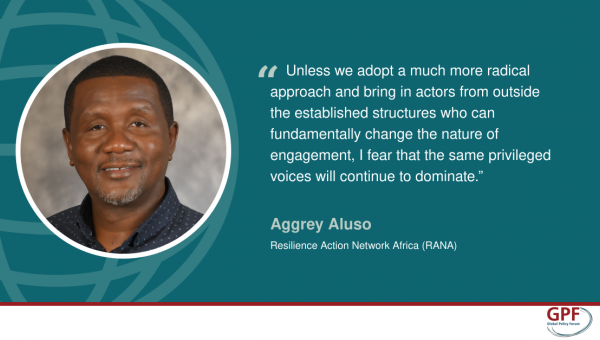
Unless we adopt a much more radical approach and bring in actors from outside the established structures who can fundamentally change the nature of engagement, I fear that the same privileged voices will continue to dominate.
To what extent do you think low- and middle-income countries will be able to shape the reform agenda?
Aggrey Aluso: I am sceptical. I think low- and middle-income countries will influence the process to some extent, but not substantially. Their contributions may shape what is politically acceptable, but I do not expect the agenda to be fundamentally driven by their perspectives.
The current participation structures already restrict the process, which remains largely government-led. With all due respect, our governments are not always sufficiently invested in these issues. They do not necessarily feel the consequences as directly as their citizens do, and they often become more vocal only when an issue has significant political implications.
This is one reason why discussions have focused so heavily on financing rather than decision-making. The involvement of civil society organisations, particularly in low- and middle-income countries, remains inadequate.
The process should have been deliberately designed from the bottom up. We should have allowed sufficient time—perhaps three years—with the first year dedicated to meaningful national consultations involving different stakeholders. These consultations could have produced national positions that would then be harmonised at regional, subregional and continental levels.
African leaders have been calling for greater African agency and sovereignty and for a shift in power through the Accra Reset initiative. How do you see the relationship between these ideas and the current WHO-led reform process? Is there potential to incorporate them into the broader debate?
Aggrey Aluso: The WHO-led process recognises the value of shifting power away from centralised structures towards the regions. Given current circumstances, I think this makes sense.
When decisions depend on a centralised authority that is far removed from where problems arise, responses can be delayed by bureaucratic bottlenecks. Before Africa CDC began declaring health emergencies, for example, activating a major response often depended on the bureaucratic processes of the WHO.
The more we decentralise power and decision-making to regions and, where appropriate, to the lowest feasible level—while maintaining global coordination and common normative standards—the better equipped we will be to respond quickly and effectively to health emergencies.
The Accra Reset initiative also raises important questions about health sovereignty and reforming the financing architecture. One of the greatest structural challenges is that health depends on countries' ability to purchase essential goods and services, while their fiscal space is constrained by the global financial architecture.
These issues are interconnected. We need to recognise the importance of sovereignty, decentralised leadership and the capacity to manufacture medical products and manage health systems at regional and local levels.
I see a clear opportunity for the Accra Reset initiative and the WHO-led process to complement each other rather than work at cross-purposes or compete. Stronger regions that can manage their own affairs would also make the WHO's work easier by enabling faster responses and stronger regional support.
I was encouraged by the recent response to Ebola. It was far from perfect, but I saw African countries contributing to the response, which has not always been the norm. In the past, emergency responses often depended on the usual donors and global powers, including the EU and the United States.
Every country has something to contribute, even if it is human resources rather than financial resources. Moving towards continental-level funds is another positive step. The African Union has taken up the idea of a sovereignty fund, which I understand has been approved.
These are encouraging developments. I hope the WHO-led process will support them.
How could the reform process address structural inequalities in research, innovation, technology transfer and access to health products? What would be needed?
Aggrey Aluso: Ideally, more democratic governance would help address these inequalities. If we achieve a global health architecture that reflects demographic and epidemiological realities, and that is guided by scientific evidence, we could move towards a more equitable system.
That could help foster recognition that global health security is best protected when countries can access technology, cooperate on technical matters without coercion, and work together on mutually beneficial terms rather than through transactional arrangements.
However, I would not place too much hope in this particular process delivering such changes. Alongside the global health architecture reform, we are witnessing protracted negotiations intended to establish more balanced technical cooperation and a mutually beneficial multilateral system. Yet these negotiations continue to encounter resistance from actors seeking to preserve their advantageous positions.
The same tensions will emerge when decisions are made about how to reorganise global health governance. Some actors will be reluctant to relinquish power, and vested interests will continue to exert influence.
I therefore want to keep my expectations realistic, while remaining hopeful that progress is possible.
What role should civil society play in the debates on global health architecture reform?
Aggrey Aluso: Ideally, civil society should have played a foundational role in mobilising perspectives and creating the basis for these discussions. Unfortunately, that train has already left the station. The process has moved to a different level of conversation.
Nevertheless, civil society must continue to hold the actors involved in the negotiations accountable for their commitments to an equitable global health system. We must demand meaningful, representative participation and ensure that civil society perspectives inform the process.
As I mentioned earlier, however, the current participation structures are inadequate. Even if you are invited, there is no guarantee that you will have an opportunity to speak. Unless you represent a large multilateral organisation with an established profile, it is difficult to be heard. Those of us working with grassroots organisations have far fewer opportunities.
Civil society has an important role to play, and we need to double our efforts within the limited time available. But resources are a major constraint. A lot of us in this space are already very limited in terms of endowment with a lot of cutbacks.
If there were one message you would want decision-makers involved in the process to hear, what would it be?
Aggrey Aluso: It benefits the world and everybody, if we can have a global health architecture that is fit for purpose, and that can secure the world's health security in this critical moment, when the risks are heightened.
Self-defeating and self-serving approaches, such as those we currently see, are hugely counterproductive. Many of the threats we face could have been avoided if we had a functional global health architecture.
I think we should safeguard our health as a global public good that is governed by those who are having a stake in it and that's everybody, including the civil society organisation. Let's be selfish and safeguard our health so that we can benefit from the other things that are all available for us to play with.
