Cover_Neue Allianz für Ernährungssicherheit
Die Initiative „New Alliance for Food Security and Nutrition“ (G8NA) wurde auf dem G8-Gipfel im Mai 2012 in Camp David auf Initiative der US-Regierung gestartet. Das erklärte Ziel ist es, 50 Millionen Menschen in Sub-Sahara Afrika bis zum Jahr 2022 aus der Armut zu befreien. Mehr private Investitionen in die Landwirtschaft sollen dies möglich machen. Die G8NA umfasst die G8-Regierungen, die Privatwirtschaft und afrikanische Regierungen.
Bislang wurden Partnerschaftsabkommen (Country Cooperation Frameworks) mit sechs afrikanischen Staaten abgeschlossen: Äthiopien, Burkina Faso, Elfenbeinküste [...]
Der internationalen Entwicklungs- und Umweltpolitik stehen entscheidende Weichenstellungen bevor. In den vergangenen Jahren war sie geprägt von den Millenniumsentwicklungszielen mit dem Zieljahr 2015. In den kommenden drei Jahren muss nun über die Zukunft der MDGs entschieden werden. Dabei geht es um weit mehr als nur die Verlängerung der Laufzeit oder die Erweiterung des Zielkatalogs.
Die Vereinten Nationen sprechen von der „Post-2015-Entwicklungsagenda“ d.h. es geht grundsätzlicher um die Prioritäten, Konzepte und Strategien von Entwicklungspolitik nach dem Jahr 2015. Zugleich wurde bei [...]
Growing inequalities and unregulated finances are expropriating people everywhere from their fair share in the benefits of global prosperity. The Social Watch Report 2012 concentrates on the effects of present mismangements and false recepies on the rights and well-being of future generations. “The ‘right to a future’ is the most urgent task of the present,” writes Roberto Bissio, coordinator of Social Watch, member of the Reflection Group and editor-in-chief of the study. “It is about nature, yes, but it is [...]
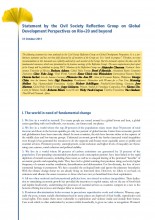
The world faces an unprecedented coincidence of global crises. They testify to the failure of the dominant model of development and economic progress that is oriented on a technocratic modernisation path, is blind to human rights and the ecological limits of the global ecosystem, confuses growth of Gross Domestic Product with progress in society, and regards poverty as a primarily technical challenge in which categories of inequality and social justice are neglected.
The Civil Society Reflection Group on Global Development [...]
Vom 20. bis 22. Juni 2012 findet in Rio de Janeiro die Konferenz der Vereinten Nationen für nachhaltige Entwicklung statt. Zwanzig Jahre nach dem ersten Erdgipfel von Rio treffen sich dort erneut Staats- und Regierungschefs aus aller Welt sowie tausende Vertreter aus Politik, Zivilgesellschaft, Wirtschaft und Medien, um über die Lösung globaler Zukunftsprobleme zu beraten.
Der Report „Rio+20“ bietet Hintergrundinformationen zu diesem Großereignis. Im ersten Teil gibt er im Zeitraffer einen kurzen Überblick über 40 Jahre internationale Umwelt- und Entwicklungsdiplomatie [...]
On 31 October 2011 the Reflection Group submitted a statement to the secretariat of the Rio+20 Conference to be held in June 2012. It was prepared during a drafting session in October in New Paltz, NY and highlights some of the issues and proposals that will come up in the final report of the Reflection Group again. The final report will come out in spring of 2012 after a final meeting of the Group.
Over the years since the Millennium Summit, the MDGs have proved to be an instrument of development policy that is both effective as publicity and suitable for campaigns. They are easy to understand and to communicate to a broader public. The civil society and UN campaigns on the MDGs have contributed to enhancing public awareness of the problems of poverty and hunger in the countries of the South – including not only those people especially concerned with development. Under the [...]
Zehn Jahre sind vergangen, seit die Staats- und Regierungschefs aus mehr als 150 Ländern im Jahr 2000 in New York die Millenniumerklärung der Vereinten Nationen verabschiedeten. Sie enthält unter anderem ein Set von international vereinbarten Entwicklungszielen, die in der Folge als Millenniumsentwicklungsziele (MDGs) zum Leitmotiv der internationalen Entwicklungspolitik avancierten.
Fünf Jahre vor dem Zieljahr 2015 steht eine letzte große Zwischenbilanz an. Was wurde bei der Verwirklichung der Ziele bisher erreicht, wo gab es Fehlschläge und Rückschritte? Welche Auswirkungen hat die [...]
Die Tsunami-Wellen der globalen Wirtschafts- und Finanzkrise haben viele Länder Afrikas, Asiens und Lateinamerikas zeitlich verzögert, dafür aber mit voller Wucht erfasst. Die Rohstoffpreise sind eingebrochen und erholen sich erst langsam, die Nachfrage nach Exportgütern sank massiv. Private Kapitalflüsse in die Entwicklungs- und Schwellenländer sind ebenso zurückgegangen wie die Überweisungen von ArbeitsmigrantInnen in ihre Heimatländer. Die Verschuldungsindikatoren vieler Länder verschlechterten sich – eine neue Schuldenkrise droht. In vielen Entwicklungsländern wachsen die Haushaltslöcher. In Kernbereichen der sozialen Grundversorgung, allen voran Bildung [...]