Publications

Report of the Reflection Group on the 2030 Agenda for Sustainable Development

Independent monitoring and review of the implementation of the 2030 Agenda and its structural obstacles and challenges are key factors for the success of the SDGs. It is for this reason, the Reflection Group on the 2030 Agenda for Sustainable Development together with other civil society organizations and networks has produced the first annual Spotlight Reportassessing the implementation of the 2030 Agenda and the structural obstacles in its realization. The report puts a spotlight on the fulfillment of the [...]

Time to reconsider their role in implementation
“Partnership” is a misleading term to cover every type of engagement between UN entities and non-State actors. It promotes a false sense of equality. Lumping CSOs and corporate actors together according to their non-State status ignores the profound differences in their orientation, interests and accountability. Before considering ways to enhance the effectiveness of partnerships between UN entities and non-State actors and establishing a system-wide delivery support, more fundamental questions should be addressed. This Background Note poses necessary questions and offers [...]
Time to reconsider their role in implementation
  • “Partnership” is a misleading term to cover every type of engagement between UN entities and non-State actors.
  • It promotes a false sense of equality. Lumping CSOs and corporate actors together according to their non-State status ignores the profound differences in their orientation, interests and accountability.
  • Before considering ways to enhance the effectiveness of partnerships between UN entities and non-State actors and establishing a system-wide delivery support, more fundamental questions should be addressed.
  • This Background Note poses necessary questions and offers [...]
Following a participative and comprehensive process over several years, in September 2015 the United Nations (UN) adopted the global Sustainable Development Goals (SDGs). The SDGs must now be implemented in and by all countires, including Germany. A wide coalition of Civil Society Organizations there thinks that fundamentally different approaches must be taken in areas of political action. "Germany must accept its responsibility for sustainable development and implement the 2030 Agenda in accordance with its five principles (people, planet, prosperity, peace [...]
Who shapes the agenda?
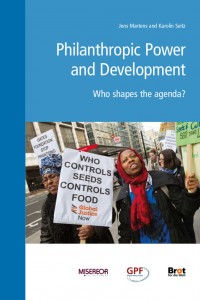
A new GPF working paper, jointly published with Brot für die Welt and MISEREOR, examines the role and impact of philanthropic foundations in development. It addresses the impacts and side effects of philanthropic engagement by taking a closer look at the priorities and operations of two of the most prominent foundations, the Rockefeller Foundation and the Bill & Melinda Gates Foundation, in two crucial sectors, health and agriculture. So far, there has been a fairly willing belief among governments and [...]
Private funding and corporate influence in the United Nations

"Follow the money” is the recipe for good investigative journalism and Fit for Whose Purpose does precisely that for the institution created to defend global public goods. Digging into the numbers behind the funding of the United Nations, Adams and Martens uncover a trail that leads to corporate interests having a disproportionate say over the bodies that write global rules. This book shows how Big Tobacco, Big Soda, Big Pharma and Big Alcohol end up prevailing and how corporate philanthropy [...]

Indispensible for a Universal Post-2015 Agenda

New Discussion paper for the Civil Society Reflection Group on Global Development Perspectives I March 2015

The Post-2015 Agenda with the Sustainable Development Goals (SDGs) as one of its key components is intended to be truly universal and global. This requires a fair sharing of costs, responsibilities and opportunities among and within countries. The principle of »common but differentiated responsibilities« (CBDR) must be applied. Coupled with the human rights principle of equal rights for all and the need to respect [...]

The EU's role in supporting an unjust global tax system 2014
Eurodad, together with partners from all over Europe (including GPF) has released a new report “Hidden Profits”. Coming right in time to complement the Luxembourg Leaks investigations, the report compares 15 EU countries’ performance on combating tax dodging and ensuring financial transparency and finds they are still failing to address urgent problems, which cost both developed and developing countries billions of euros in lost tax revenue every year. Each country is also directly compared with its fellow EU member states [...]
Comments by the Civil Society Reflection Group on Global Development Perspectives
In a new comment the the Civil Society Reflection Group on Global Development Perspectives states that the SG’s report fails to address the core structural and macro-economic issues that shape the ability to implement and finance people-centered, ecologically sound policies and programs at all levels.
Global Policy Forum, MISEREOR and Brot für die Welt launch a new working paper on the "Corporate influence through the G8 New Alliance for Food Security and Nutrition in Africa". The working paper puts a spotlight on how business interests are promoted through the G8NA. To that end, the paper shows how the initiative bundles existing policy initiatives and aligns national policies to corporate interests. The paper concludes that the approach and objectives of the G8NA are highly problematic. The [...]