Jens Martens Gesammelte Werke 2
Copyright
GPF Europe
This list, which is currently incomplete, presents the body of Jens Martens’ published work. Please send any information regarding missing publications to europe@globalpolicy.org.
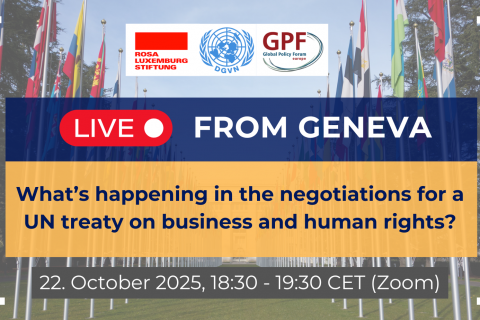
There are countless cases in which economic activities lead to human rights abuses and violations. For those affected, it’s often difficult to get justice – particularly in cases that involve translational companies. This is precisely where the current negotiations on a UN Treaty on business and human rights come in: They aim to close legal loopholes and hold companies accountable.
Since their introduction in 2024, the thematic consultations have given the negotiations a significant momentum. The legal experts – who [...]
On 17 January 2026, the European Union and the Mercosur countries (Argentina, Brazil, Paraguay and Uruguay) signed the EU–Mercosur Partnership Agreement (EMPA) and an accompanying Interim Trade Agreement (iTA) in Asunción, which marked the conclusion of the longest negotiations on a trade partnership to date. The agreement between the European Union and the South American economic alliance Mercado Común del Sur (Mercosur) was 26 years in the making and covers 30% of global gross domestic product, affecting over 700 million [...]
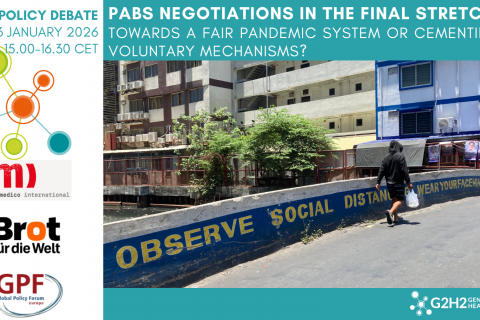
Although the Pandemic Treaty was adopted at the 78th World Health Assembly (WHA), its core mechanism for ensuring equitable access to vaccines, therapeutics, and diagnostics remains unresolved. As the World Health Assembly approaches its 79th session in May 2026, negotiations on the Pathogen Access and Benefit Sharing (PABS) System enter their final and decisive phase. In the upcoming months, governments will negotiate under intense time pressure while industry lobbying and geopolitical interests threaten to dilute or delay meaningful commitments.
PABS [...]
From October 20 to 24, 2025, negotiations on a legally binding instrument on business and human rights will take place in Geneva (11th session of the open-ended intergovernmental working group (OEIGWG) on transnational corporations and other business enterprises with respect to human rights).
The UN treaty aims to establish binding rules for companies to respect human rights and provide better access to justice for
victims of human rights violations. If adopted, it will pave the way for comprehensive legislation to [...]
After two years of negotiations, the EU Corporate Sustainability Due Diligence Directive (CSDDD) officially came into force on July 25, 2024. From July 2027, it will require large companies to respect human rights and the en vironment throughout their supply chains and to draw up and implement climate plans in line with the Paris Cli mate Agreement. Although the directive has some gaps, for example with regard to the financial sector, it is an important milestone on the road to [...]
For several weeks now, Germany has been engaged in an intense debate about the welfare state. This was triggered by a statement made by Chancellor Merz of the governing Christian Democratic Union (CDU) state party conference at the end of August: “We simply can no longer afford the system we have today.” Specifically, he wants to cut welfare payments and relieve the burden on the pension funds by making it more attractive to work into old age.
But the welfare [...]
Creating better institutions for international tax cooperation is considered a key pillar of international financial architecture reform. The first round of negotiations for a comprehensive United Nations (UN) Framework Convention on International Tax Cooperation (FCITC) has just concluded at the UN headquarters in New York City.
Building on preparations by three working groups, the negotiations lasted for two weeks and dealt with the core Framework Convention, as well as two additional protocols – on taxing cross-border services and on tax [...]
We have just launched our four-part weekly podcast series 'Global Finance Rewired', which explores the future of the international finance architecture (IFA). Hosted by our Managing Director Bodo Ellmers, the series features expert voices from the Global South to examine how global finance must change to meet today’s challenges.
From 4-6 November 2025, the United Nations (UN) will hold the second World Summit for Social Development (WSSD2) in Doha, Qatar. The first summit on social development took place 30 years ago in Copenhagen. The initiative for a new World Social Summit came from UN Secretary-General António Guterres. He had already spoken out in favour of a global summit in his 2021 Our Common Agenda report. At the time, he took up an initiative from the Club de Madrid. This [...]
From 26 to 28 February 2025, the first key events of the South African G20 presidency took place as Finance Ministers and Central Bank Governors held their inaugural meeting in Cape Town, the country’s coastal metropolis. The fifth edition of the Finance in Common Summit, the world’s major gathering of public development banks, took place at the same time, attracting around 2,000 delegates. South Africa is trying to pursue several important streams of financial architecture reforms during their Presidency, but [...]
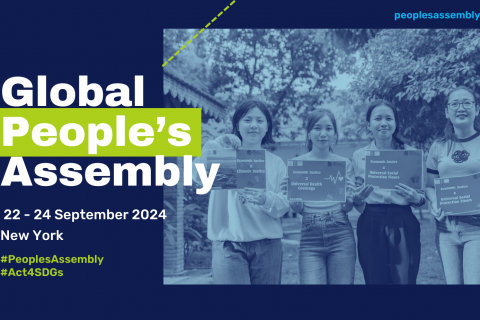
The Global People's Assembly 2024 will take place in person from 22-24 September at the UN Church Center in New York. In the PROGRAMME you will find event descriptions for everything happening over the three days. Because of technical challenges people will be able to follow online only the first day of the assembly.
Please click here to register to attend in New York in person
Please click here to register to attend the first day online
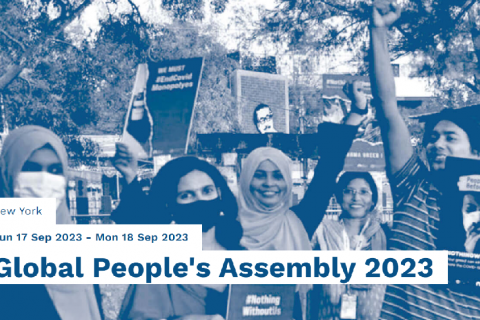
The Global People’s Assembly 2023 will be on 17 (Sunday) and 18 September (Monday) in New York – at the UN SDG Summit and the UN General Assembly.
The Global People’s Assembly (GPA) brings people’s representatives together and creates a strong voice at the SDG Summit for the midpoint of Agenda 2030. The assembly will be in-person in the Church Centre of the UN (opposite the UN), with 300 participants expected. Participants can also join online — we look forward [...]
As Agenda 2030 passes its mid-way point, ambitious reforms will be required during its second phase if the Sustainable Development Goals (SDGs) are still to be achieved. A lack of financial resources is one of the main reasons why their implementation has fallen so far behind. The UN’s latest Financing for Sustainable Development Report has identified the “financial divide”, i.e. the lack of access to funds at favourable interest rates for countries of the Global South, as a key problem [...]
The implementation of the 2030 Agenda has fallen massively behind. Insufficient development finance is a major reason for this, as the slowly subsiding COVID-19 crisis had led to a simultaneous collapse of all sources of finance. This year's UN High Level Forum on Sustainable Development (HLPF) should have been dedicated to building back better after the crisis. The title did retain the "building back better." De facto, however, the HLPF was overshadowed by a new wave of [...]
Brussels, 31st of March, 2022.
Subject: Ensuring a gender-responsive and effective Corporate Sustainability Due Diligence legislation
Dear President of the European Commission Ursula von der Leyen,
Dear Vice-President Vera Jourová,
Dear Commissioner Thierry Breton,
Dear Commissioner Helena Dalli,
Dear Commissioner Didier Reynders,
Dear Members of Parliament,
Dear Council of the European Union Representatives,
On March 8th, we celebrated International Women’s Day and paid tribute to the women who defend human rights and the environment across the world [...]
More than 600 organizations worldwide are calling for the IPCC WGIII Co-Chairs and Focal Points to fulfill their responsibility to ensure that the IPCC Report on mitigation measures clearly conveys to the global community the urgency of the crisis and the central role of fossil fuels.
From October 24 to 26 health experts from around the globe gathered in Berlin for this year’s World Health Summit. Approximately 6000 participants – both virtually and on-site – discussed current trends and challenges in global health. Obviously, the main theme was the ongoing pandemic health crisis. While there was a lot of talk in a lessons learned fashion, the pandemic is far from over. As many attendants including WHO Director-General Tedros underscored, the number one global [...]