Harris Gleckman has published an article titled ‘ECOSOC’s New Role and Its Old Culture’. The article written for iisd surrounds the extensive reforms made to the Economic and Social Council (ECOSOC). After the latest reform resolution, four distinct new elements to ECOSOC have appeared following the governments agreement on new operating rules for the council.
Nachhaltige Entwicklung und Menschenrechte
The Working Group on "Financing for sustainable development" of the socalled UN System Task Team (UNTT) has issued four background papers for the Intergovernmental Expert Committee on Sustainable Development Financing and its deliberations surrounding the post-2015 UN development agenda. Paper #1 reviews investment requirement estimates that have been published over the last decade for nine sectors; paper #2 takes stock of national, regional and international public sources for sustainable development finance; paper #3 examines the challenges in raising private sector [...]
For a transformative shift in gender equality in Post-2015 Era
The Women’s Major Group (WMG) responds to the Special Event convened by the President of the UN's General Assembly to review progress towards the achievement of the Millennium Development Goals, and to chart the way forward. In acknowledging the achievements the Women's Major Group is nevertheless greatly concerned that without a transformative shift in the way that gender equality and women’s human rights and justice concerns are articulated, a truly sustainable post-2015 Development agenda will not be achieved.
The United Nations Special Rapporteur on extreme poverty urges States to recognize and value unpaid care work, and ensure it is better supported and more equitably shared between women and men. The UN expert states that the unequal distribution of unpaid care work, fueled by damaging gender stereotypes, is a major human rights issue. Therefore it was put on the Agenda of UN meeting in Geneva on the International Day for the Eradication of Poverty.
Will the poor be short-changed?
The OECD Development Assistance Committee (DAC) is currently reviewing the rules to report donors’ loans as Official Development Assistance (ODA). This discussion is taking place against a backdrop of aid cuts across Europe and raises concerns about the intentions of DAC donors. There are risks that the poor will be short-changed if the new rules make it easier for donors to inflate their aid figures further without making fresh money available and that debt sustainability will be undermined if loans [...]
Construction of a mega-steel plant in Odisha in Eastern India should be halted immediately, United Nations independent human rights experts have urged, citing serious human rights concerns. The project reportedly threatens to displace over 22,000 people in the Jagatsinghpur District, and disrupt the livelihoods of many thousands more in the surrounding area.
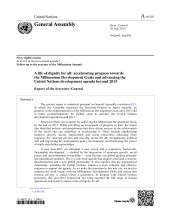
Although the Arab NGO Network for Development (ANND) welcomes the report and joins to the general call towards a life of dignity for all by the UN's Secretary General it mentions shortcomings and deficits in a newly announced comment. Amongst others ANND is concerned with the lack of interlinkages between development and trade on the one hand and Human Rights and trade on the other and calls to implement the Guiding Principles on Business and Human Rights.
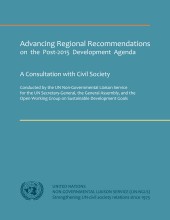
UN-NGLS has launched a report on the post-2015 development agenda which entailes a four-month consultation with 120 regional civil society networks (and includes statements from GPF). Together the networks have come up with four objectives surrounding justice, human rights, the equal distribution of resources and accountability/transparency. The report adds a more critical perspective to the recommendations by the SG's High Level Panel, the Sustainable Development Solutions Network and the Global Compact.
Asia Development Alliance (ADA) composed of development CSO/NGO platforms in Asia comment on the 2nd Regional Consultation on Post-2015 development agenda on UN level. In their newest statement ADA welcomes the way taken and formulates demands such as a need to give priority to least developed countries, landlocked developing countries, small island developing countries as well as fragile and conflict-affected countries in the Post-2015 development agenda.
The long awaited work of an experts committee on sustainable development financing, a key outcome of the Rio+20 United Nations conference, has finally started. The Intergovernmental Committee of Experts on Sustainable Development Financing held its first session on 28-30 August at the UN headquarters in New York. However, contrary to most multilateral discussions and intergovernmental processes in the UN, the session was closed to not only external stakeholders but also the Member States that are not part of the Committee [...]
