Cover_Scope of UN Treaty Business and Human Rights
The process towards a legally binding instrument on business and human rights (also known as the “UN Treaty”) has now been underway for a decade. The initiative is based on the realisation that the activities of transnationally operating companies are not sufficiently regulated under human rights law. The transnational nature of these companies, their economic power and unilaterally formulated investment protection agreements often make it difficult to hold those responsible for human rights violations accountable and to provide victims with [...]
Der Prozess hin zu einem völkerrechtlich bindenden Abkommen zu Wirtschaft und Menschenrechten (auch „UN-Treaty“ genannt) läuft inzwischen seit einem Jahrzehnt. Der Initiative liegt die Erkenntnis zugrunde, dass Aktivitäten transnational agierender Unternehmen nicht hinreichend menschenrechtlich reguliert werden. Der transnationale Charakter dieser Unternehmen, ihre wirtschaftliche Macht sowie einseitig formulierte Investitionsschutzabkommen erschweren es häufig, die Verantwortlichen von Menschenrechtsvergehen zur Rechenschaft zu ziehen und den Opfern Zugang zu Recht zu verschaffen. Es besteht gerade hinsichtlich transnational agierender Unternehmen eine erhebliche Regulierungslücke.
Länder des Globalen [...]
The event is hosted by: Abong, CCRDA, VANTI, VENRO, Forum Umwelt & Entwicklung, Friedrich-Ebert-Stiftung, GPF Europe, Heinrich-Böll-Stiftung, Netzwerk Steuergerechtigkeit, WEED
The 4th International Conference on Financing for Development (FfD4) will take place in Sevilla, Spain from June 30 to July 3, 2025. FfD4 is expected to catalyse the urgently needed policy change to mobilize the necessary funds for sustainable development and climate action. Therefore, it is expected to also set milestones in terms of reforming the international financial architecture.
From [...]
The international financial architecture is in urgent need of reform. In the words of UN Secretary-General António Guterres, it is "outdated, dysfunctional and unjust". The main institutions were created 80 years ago in a transatlantic agreement, at a time when many of the world's nation-states of today were still colonies. Moreover, the institutions have failed in their mission to prevent and mitigate crises and to mobilize sufficient financing for internationally agreed development goals.
The reform of the international financial architecture [...]
Die Weltgesundheitsorganisation (WHO) hat eine sogenannte Investment Round gestartet, um für die nächsten vier Jahre von ihren Mitgliedstaaten, internationalen Organisationen und privaten Geldgebern die dringend benötigten Mittel zur Finanzierung globaler Gesundheitsaufgaben zu mobilisieren. Die WHO schätzt die Finanzierungslücke für die Jahre 2025 – 2028 auf 7,1 Mrd. US-Dollar. Ob diese Lücke geschlossen werden kann, wird sich beim G20-Gipfel am 18.-19. November 2024 in Rio de Janeiro zeigen. Dort soll die Investment Round ihren Höhepunkt erreichen. Bislang wurden lediglich Finanzzusagen von [...]
Am 22. September 2024 verabschiedeten die Mitgliedstaaten der Vereinten Nationen den Pakt für die Zukunft. Er ist das offizielle Ergebnisdokument des UN-Zukunftsgipfels, der zu Beginn der 79. Generalversammlung in New York stattfand. Der Gipfel sollte angesichts verschärfter geopolitischer Konfrontationen die multilaterale Kooperation auf Weltebene wiederbeleben und die Vereinten Nationen fit für die Zukunft machen.
Der Zukunftspakt ist kein großer Wurf. Dies war angesichts der weltpolitischen Großwetterlage auch nicht zu erwarten. Dass es nach monatelangen hitzigen Verhandlungen überhaupt ein offiziell einvernehmliches [...]
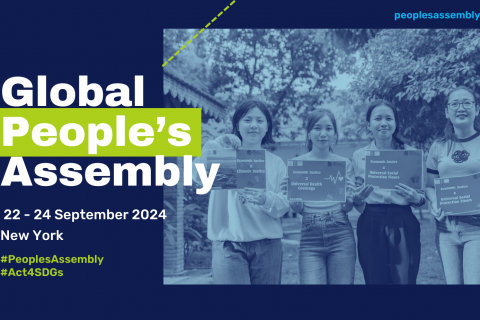
The Global People's Assembly 2024 will take place in person from 22-24 September at the UN Church Center in New York. In the PROGRAMME you will find event descriptions for everything happening over the three days. Because of technical challenges people will be able to follow online only the first day of the assembly.
Please click here to register to attend in New York in person
Please click here to register to attend the first day online
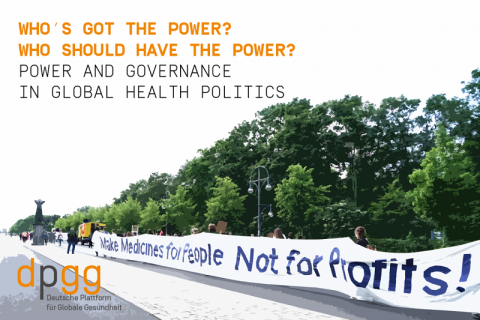
Who has the power and who should have the power? These questions are of great importance for the state of global health but all too often receive little atten- tion. This gap is also visible in the programme of the annual World Health Summit, which is taking place again in Berlin in October. We would therefore like to discuss these questions at a parallel event and look forward to welcoming you there.
Who has the power? Which health issues make [...]
Am 22. und 23. September 2024 findet bei den Vereinten Nationen in New York der Zukunftsgipfel (Summit of the Future) statt. An ihn sind hohe Erwartungen geknüpft. Angesichts verschärfter geopolitischer Konfrontationen sollen die multilaterale Kooperation auf Weltebene wiederbelebt und die Vereinten Nationen fit für die Zukunft gemacht werden. UN-Generalsekretär António Guterres erhofft sich vom Gipfel einen Booster Shot für die Agenda 2030 und ihre Ziele für nachhaltige Entwicklung (SDGs). Ergebnis des Gipfels soll ein Pakt für die Zukunft sein. Seine [...]