
Cover Fit for whose purpose? REPORT
Der Privatwirtschaft wird in der internationalen Umwelt- und Entwicklungspolitik zunehmende Bedeutung beigemessen. Immer mehr Unternehmen beteiligen sich an Initiativen zur Umsetzung internationaler Umwelt-, Sozial- und Menschenrechtsstandards und informieren in Nachhaltigkeitsberichten über die gesellschaftsbezogenen Auswirkungen ihrer Tätigkeit.
Zugleich sind es aber auch Wirtschaftsunternehmen und ihre Lobbygruppen, die gegenüber der Politik verbindliche Maßnahmen zur Durchsetzung der Menschenrechte, zur Regulierung der Finanzmärkte und zum ökologischen Strukturwandel der Wirtschaft ablehnen. Nicht selten verfolgen Unternehmen und ihre Interessenverbände eine Doppelstrategie: Auf der einen Seite demonstrieren [...]
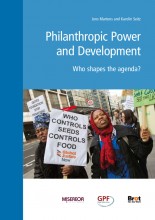
"Follow the money” is the recipe for good investigative journalism and Fit for Whose Purpose does precisely that for the institution created to defend global public goods. Digging into the numbers behind the funding of the United Nations, Adams and Martens uncover a trail that leads to corporate interests having a disproportionate say over the bodies that write global rules. This book shows how Big Tobacco, Big Soda, Big Pharma and Big Alcohol end up prevailing and how corporate philanthropy [...]
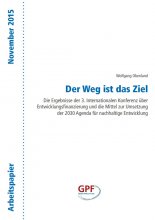
Das Jahr 2015 ist zweifellos bedeutend für die internationale Nachhaltigkeitspolitik. Gleich drei Weltkonferenzen finden innerhalb von nur fünf Monaten statt. Im November soll in Paris ein Nachfolger für das Kyoto-Protokoll auf den Weg gebracht werden. Im September tagen bei den Vereinten Nationen in New York die Staats- und Regierungschefs, um eine Agenda nachhaltiger Entwicklung für die Zeit nach 2015 (Post-2015-Agenda) zu verabschieden. Den Anfang aber macht vom 13. bis 16. Juli die 3. Internationale Konferenz über Entwicklungsfinanzierung (FfD3) in Addis [...]
The outcome document for the Third International Conference on Financing for Development (FfD3) is being finalized at the United Nations in New York. This is a key moment to make an assessment and influence the issues under negotiation to ensure progress is not lost in the interests of fact-tracking consensus. The outcome document must establish new ground on a range of issues such as combatting illicit financial flows and global tax cooperation.
Key to this is action on proposals of [...]
Civil society has put forward and worked hard to defend a vision of a new Post-2015 Agenda that will approach human rights, environmental integrity and the urgency of dealing with climate change in a way that addresses the injustice and inequity inherent in gender, social, political and economic relations at all levels.
As we approach the final phase of agreeing on the framework, there are clear indications that we are further from reaching this vision in the post-2015 agreement than [...]
Civil society organizations and social movements around the world struggling against corporate abuse achieved a first victory in June last year when the UN Human Rights Council adopted Resolution 26/9, establishing an Intergovernmental Working Group whose the mandate shall be to elaborate an international legally-binding instrument to regulate the activities of business enterprises. However, there remain important challenges to ensure that a robust treaty ensuring genuine corporate accountability and access to justice will be drafted in a participatory and transparent [...]
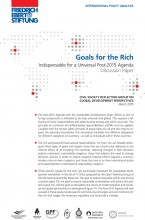
New Discussion paper for the Civil Society Reflection Group on Global Development Perspectives I March 2015
The Post-2015 Agenda with the Sustainable Development Goals (SDGs) as one of its key components is intended to be truly universal and global. This requires a fair sharing of costs, responsibilities and opportunities among and within countries. The principle of »common but differentiated responsibilities« (CBDR) must be applied. Coupled with the human rights principle of equal rights for all and the need to respect [...]
The event aims at exploring the question of how women’s organizations and feminist movements can influence governmental decision-making. What strategies have proven to be effective to ensure policy agendas and laws reflect women’s interests? What are the factors and conditions under which non-state actors can effectively trigger and influence policy change?
Speakers:
Elisa Vega Sillo, Office for Depatriarchalization of the Vice-Ministry of Decolonization, Bolivia
Nitya Rao, University of East Anglia, Great Britain
Anne-Marie Goetz, New York University, United States
Rob [...]