Shadow reporting is a well-established tool of civil society when it comes to holding governments accountable. A number of CSOs have already started to prepare shadow or spotlight reports or similar monitoring accounts to follow-up on their governments efforts to implement the 2030-Agenda, especially its 17 goals and 169 targets. The main focus in this first year’s reports was to devise and discuss methodologies and to monitor governments’ efforts on drafting national implementation plans or strategies. In future reports they [...]
Cross-cutting
Civil Society Action for meaningful participation and accountability
Civil Society Reflection Group Report Launch: Spotlight on Sustainable Development 2016
Independent monitoring and review of the implementation of the 2030 Agenda and its structural obstacles and challenges are key factors for the success of the SDGs. It is for this reason, a global alliance of civil society organizations and networks has agreed to produce an annual Spotlight Report assessing the implementation of the 2030 Agenda and the structural obstacles in its realization. The report puts a spotlight on the fulfillment of the 17 goals, with a particular focus on inequalities [...]
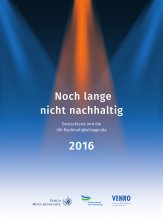
Noch lange nicht nachhaltig
Die 2030-Agenda der Vereinten Nationen und ihre 17 Ziele für nachhaltige Entwicklung versprechen die Transformation unserer Welt. Sie gelten für jedes Land, für die Länder des globalen Südens und des globalen Nordens, und damit auch für Deutschland. Gemeinsam mit VENRO, Forum Menschenrechte, Forum Umwelt und Entwicklung, terre des hommes und Open Knowledge Foundation hat das Global Policy Forum nun den Bericht „Deutschland und die UN-Nachhaltigkeitsagenda 2016 - noch lange nicht nachhaltig“ herausgegeben. Darin ziehen 40 Expertinnen und Experten kritisch Bilanz [...]
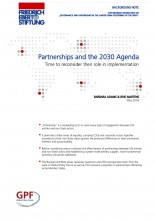
Time to reconsider their role in implementation
“Partnership” is a misleading term to cover every type of engagement between UN entities and non-State actors. It promotes a false sense of equality. Lumping CSOs and corporate actors together according to their non-State status ignores the profound differences in their orientation, interests and accountability. Before considering ways to enhance the effectiveness of partnerships between UN entities and non-State actors and establishing a system-wide delivery support, more fundamental questions should be addressed. This Background Note poses necessary questions and offers [...]
Time to reconsider their role in implementation
- “Partnership” is a misleading term to cover every type of engagement between UN entities and non-State actors.
- It promotes a false sense of equality. Lumping CSOs and corporate actors together according to their non-State status ignores the profound differences in their orientation, interests and accountability.
- Before considering ways to enhance the effectiveness of partnerships between UN entities and non-State actors and establishing a system-wide delivery support, more fundamental questions should be addressed.
- This Background Note poses necessary questions and offers [...]

Der "Treaty-Prozess" bei den Vereinten Nationen über ein internationales Menschenrechtsabkommen zu Transnationalen Konzernen und anderen Unternehmen
Es war eine historische Entscheidung, als der UN-Menschenrechtsrat im Juni 2014 eine Arbeitsgruppe einsetzte, um ein rechtsverbindliches Instrument zu formulieren, mit dem transnationale Konzerne und andere Wirtschaftsunternehmen für Menschenrechtsvergehen zur Verantwortung gezogen werden können. Ein neues Arbeitspapier von Global Policy Forum und Rosa-Luxemburg-Stiftung liefert Basisinformationen zu den aktuellen Diskussionen im UN-Menschenrechtsrat, dem sogenannten „Treaty-Prozess“. Es skizziert die Vorgeschichte der gegenwärtigen Diskussionen, beschreibt politische Kontroversen und Konfliktlinien, erläutert die möglichen Inhalte eines Abkommens und formuliert abschließend einige Schlussfolgerungen für den weiteren [...]

Einfluss privatwirtschaftlicher Akteure in internationalen Politikprozessen
In den vergangenen Jahren haben sich die ökonomischen, sozialen und ökologischen Krisenerscheinungen weltweit verschärft. Immer deutlicher wird, dass eine Politik des business as usual keine Option sein kann. Gefordert ist eine aktivere Rolle der Politik auf nationaler und internationaler Ebene, um die „große Transformation“ hin zu einer zukunftsgerechten Entwicklung weltweit zu ermöglichen. Aber bislang blieben die dazu notwendigen politischen Durchbrüche weitgehend aus. Die Beharrungskräfte gegen die „große Transformation“ haben häufig weiterhin die Oberhand. In einer neuen Publikation zeigen Brot für [...]
Following a participative and comprehensive process over several years, in September 2015 the United Nations (UN) adopted the global Sustainable Development Goals (SDGs). The SDGs must now be implemented in and by all countires, including Germany. A wide coalition of Civil Society Organizations there thinks that fundamentally different approaches must be taken in areas of political action. "Germany must accept its responsibility for sustainable development and implement the 2030 Agenda in accordance with its five principles (people, planet, prosperity, peace [...]
Globale Zukunftsziele für nachhaltige Entwicklung
Am 25. September 2015 verabschiedeten die 193 Mitgliedsstaaten der Vereinten Nationen auf einem Gipfeltreffen in New York die 2030-Agenda für nachhaltige Entwicklung. Sie bildet den globalen Rahmen für die Umwelt- und Entwicklungspolitik der kommenden 15 Jahre. Kernstück der Agenda sind die 17 Ziele für nachhaltige Entwicklung, die SDGs, mit ihren 169 Zielvorgaben. Grundlage für das kritische Engagement politischer und zivilgesellschaftlicher Akteure im 2030-Prozess ist die ausreichende Information über die SDGs, ihre Zielvorgaben, die Herausforderungen und Kontroversen, die mit ihrer Umsetzung [...]
Trends, Risiken und Nebenwirkungen
In der internationalen Entwicklungspolitik hat in den letzten Jahren eine Akteursgruppe in der Grauzone zwischen Zivilgesellschaft und Wirtschaft an Bedeutung gewonnen: Philanthropische Stiftungen.
US-amerikanische Stiftungen wie die Rockefeller Foundation sind bereits seit dem frühen 20. Jahrhundert in der internationalen (Entwicklungs-)Zusammenarbeit aktiv. Aber erst in den letzten Jahren haben sich mit der wachsenden Anzahl von Stiftungen und vor allem mit der Gründung der Bill & Melinda Gates Foundation deren finanzielle Leistungen rapide erhöht. In Zeiten stagnierender öffentlicher Mittel für die Entwicklungszusammenarbeit [...]
