

cover new era of world hunger
Die Millenniumsentwicklungsziele (Millennium Development Goals, MDGs) sind seit ihrem Proklamation im Jahr 2000 zum Leitmotiv der internationalen Entwicklungspolitik avanciert. Mit ihnen richtete sich der entwicklungspolitische Diskurs von Regierungen und internationalen Organisationen auf die Bekämpfung der extremsten Formen von Armut und Hunger sowie die soziale Grundversorgung der Bevölkerung, insbesondre einen Bereichen Grundbildung, Gesundheit nd Wasserversorgung. Die meisten MDGs sind mit klaren quantitativen, und damit überprüfbaren Zielvorgabenverbunden, die überwiegend bis zum Jahr 2015 erreicht werden sollen.
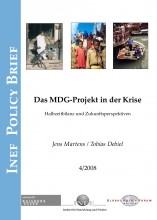
Jens Martens and Tobias Debiel point out that the Millennium Development Goals (MDGs) are much less ambitious than previous international development goals. Even so, the UN, World Bank and NGOs agree that most countries will not achieve most of the MDGs on time. The authors further argue that the MDGs fail to deal with the structural root causes of poverty, such as unequal distribution of wealth, land and political power, as well as unfair global trade rules.(Institute for Development [...]
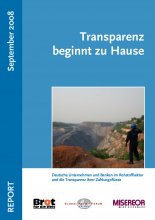
Die globalen Rohstoffmärkte erlebten in den vergangenen Jahren einen nie dagewesenen Boom. Der Preis für Erdöl durchbrach am 19. Februar 2008 die Schwelle von 100 US-Dollar pro Barrel. Gold wurde an den Börsen am 13. März 2008 erstmals für über 1.000 US-Dollar je Feinunze gehandelt. Der Preis war damit binnen eines Jahres um 55 Prozent gestiegen. Für Kupfer muss man auf dem Weltmarkt heute fast sechsmal soviel bezahlen wie noch vor sechs Jahren. 2002 lag der Preis bei 1.540 US-Dollar [...]
This paper discusses the main causes of the steep run-up in global food prices and the resulting spread of hunger to nearly a billion people worldwide. Authors James A. Paul and Katarina Wahlberg conclude that biofuels and the agro-industrial approach to food production are the main culprits of the food crisis. The paper looks at a wide range of factors endangering nutrition for all, including population growth, unsustainable consumption, international trade policy and climate change. The authors argue for effective [...]
Trotz einiger Fortschritte bei der quantitativen und qualitativen Steigerung der öffentlichen Entwicklungszusammenarbeit bleibt noch viel zu tun, um die zur Finanzierung der internationalen Entwicklungsziele, einschließlich der Millenniumsentwicklungsziele (MDG), nötigen Finanzmittel in ausreichendem Umfang zu mobilisieren. Die Regierungen der EU haben zwar einen Stufenplan zur Erhöhung deröffentlichen Entwicklungshilfe (»Official DevelopmenmAid« – ODA) auf 0,7 Prozent des Bruttonationaleinkommens (BNE) bis zum Jahr 2015 vereinbart, die Realisierung ist aber noch lange nicht sichergestellt − auch nicht in Deutschland. Zudem zeichnen sich neue Herausforderungen [...]
Global Policy Forum's Katarina Wahlberg criticizes the World Bank's proposal to create a Green Revolution in Africa. By focusing on boosting agricultural production through scientific development of more productive crops, the Bank disregards the fact that the Earth's biological systems cannot be exploited forever. The supporters of the new Green Revolution also fail to address the major causes of the global food crisis, including biofuel production and unsustainable global consumption of meat. The author calls for a shift from industrial [...]
Amid all the talk about the US military "surge" in Iraq, little has been said about the accompanying "surge" of Iraqi prisoners, whose numbers rose to nearly 51,000 at the end of 2007. Global Policy Forum's Ciara Gilmartin states that "US forces hold nearly all detainees indefinitely without charge, an arrest warrant or the opportunity to defend themselves." Human rights monitors, including the United Nations Assistance Mission in Iraq (UNAMI), are denied access to detention centers in Iraq by US [...]
Ob die internationalen Entwicklungsziele, allen voran die MDGs, bis zum Jahr 2015 verwirklicht werden, ist auch eine Frage des Geldes. Ohne ausreichende finanzielle Mittel können in den Ländern des Südens weder Schulen, Gesundheitsstationen, Straßen oder Wasserleitungen gebaut noch die Gehälter von Lehrern, Krankenschwestern oder Verwaltungsbeamten bezahlt werden. Bislang reichen die Mittel bei weitem nicht aus – trotz der vollmundigen Versprechen, die die Regierungen in den letzten Jahren abgegeben haben. Vom 29. November bis 2. Dezember 2008 findet in Doha, der [...]
On April 28, 2008 the Security Council will discuss Iraq and receive a report from the US on the Multinational Force (MNF). In anticipation of this debate, Global Policy Forum and International Federation for Human Rights call for greater attention to the extrajudicial and arbitrary detention of large numbers of Iraqis held by the MNF, including some 20,000 held in a vast prison camp in the southern desert.